More on Swarms

Sometimes I’m lucky enough to notice that the bees when the bees just begin to swarm and are swirling around our backyard.  Whenever possible I stand in the middle of the yard and listen to the hum of thousands of bees.  Sometimes I’ve done this and watched them, not form a football-shaped ball around a queen, but return to the very hive they poured out of.

This is an amazing sight for a few reasons.  One is how quickly the message to return gets disseminated amongst the bees.  One moment there is what appears to be chaos with bees flying in many directions and landing on many plants (and me).  The next they have all returned to the hive. Throughout all of this the bees not involved in the swarm continue about their tasks.  The bees somehow communicate with each other and manage to not run into their sisters.

Hive entrance busy with bees returning from a swarm.

Hive entrance busy with bees returning from a swarm.

The first photo shows of a busy hive entrance.  There are bees returning with pollen and other bees leaving to gather the goods, as well as bees returning from a sort of practice swarm flight around the garden.

Swarms happen in Spring  – but what happens is open to interpretation.  Inside the hive the bees raise new queens.  One of these new queens rises to power inside the hive by fighting and killing off her rivals.  However she doesn’t kill the old queen.  Some experts say the bees know when the old queen is running out of eggs and kick her out.  However, she may choose to go… she certainly does not go quietly.  Instead the old queen takes enough bees with her to start up a new hive or colony.

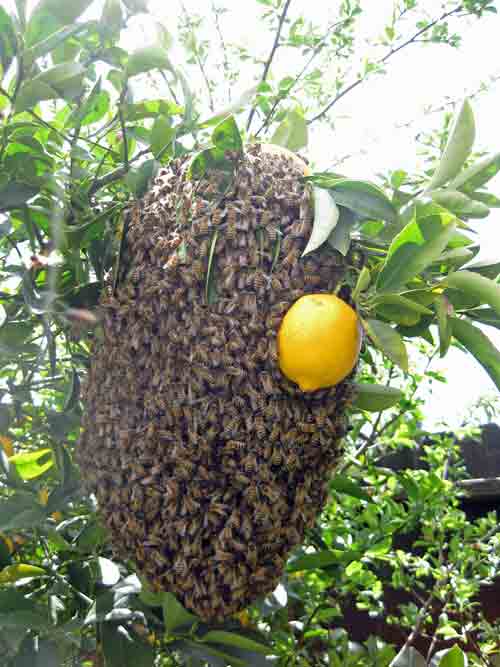
The second swarm of this season settled in our neighbor’s lemon tree.  Fortunately one of
Swarm in lemon tree.

Swarm in lemon tree.

our neighbors was home and she granted us permission to go into the back.  For this she will be rewarded with much honey.

To gather this swarm, we put an empty hive body on a wagon, and rolled it over to the neighbor’s back yard.  Here we shook the branch the bees were on and caught the majority of the bees in a hive.  Then we restricted the entrance with grass.  The hope was that we caught the queen.  A few bees took flight when we shook the branch and then resettled on the lemon tree.  We trimmed the small branch they had settled on and placed it on top of the hive.  Then rolled the hive back to our yard.
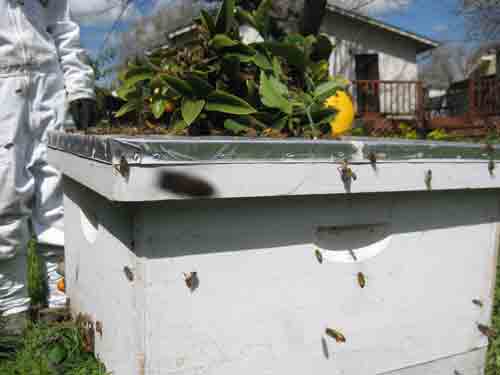
Hive houses a swarm with lemon branch on top.
Hive houses a swarm with lemon branch on top.

Posted in Bees and Honey | Leave a comment

Hiving a Swarm

Every March, the honey bees start swarming.  The old queen leaves the hive and thousands of bees go with her.  Since the queen does not fly very well, she usually lands someplace near her old home.  The hum and flight of 20,000 swarming bees captures the excitement of Spring.  I love to stand amidst swarming bees… yes, they land on me, but they are not aggressive.  They are too busy locating the queen and fanning her smell to other bees.  In a short period of time, twenty minutes or so, what appears to be chaos settles down.  Most of the queen’s followers gather around her in a tight ball.  Meanwhile a few scout bees look for a more permanent location.

While the bees are clinging to the queen and before they choose a permanent site is a great time to move the bees into a location of your choice, preferably a hive body.  Swarming bees have nothing to defend.  They will go wherever the queen goes.  If you can convince the queen to enter and stay in a hive, the bees will follow her and set up a new home.

If you don’t have the queen in your hand, how do you move a swarm?  The answer depends mostly on the location of the swarm.  We have cut branches off trees and shaken the swarm into a hive, and we’ve swept the bees off porch roofs.  Moving the bees has required some team work – one person to move the bees and the other to catch them.  In this video, the swarm originally came together in a low branch on a peach tree.  They were easily accessible (not always the case).  This location made it possible for us to create the video.

Although I have moved swarms while not wearing any protective bee gear and was not stung, I don’t recommend this.  Allergic reactions are not something I have or want to develop!

Posted in Uncategorized | Leave a comment

First Swarm of Spring 2011

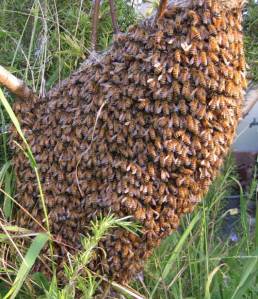
First swarm of 2011

First swarm of 2011

Swarm season begins on the first sunny day in March.  This swarm settled in a low branch of our peach tree.  In the morning we used a brush to sweep the bees into a hive body.  In addition we were able to video how we transferred the bees… and once I figure out how to post a video, you too will see how calm swarming bees are.  The trick is to move the Queen, the rest of the bees will follow.

Posted in Uncategorized | Leave a comment