Book Review: Peculiar Home

Cover of Miss Peregrine's Home for Peculiar Children

Cover of Miss Peregrine's Home for Peculiar Children

Miss Peregrine’s Home for Peculiar Children
By Ransom Riggs

This book is a quirky, fun, adventure that transports a modern American teenager through space into an isolated Welsh island, and through time to World War II. In Florida, Jacob finds his grandfather as the old man is dying and receives abbreviated instructions from him. After some psychological turmoil, Jacob and his father visit the island where the grandfather lived. Here Jacob finds a group of children with special talents that are living the same day over and over in a kind of time loop. They are being persecuted by others, and need Jacob’s help in order to survive.

The story is illustrated with photographs that seem to send the story off into new directions. Most of these photographs appear to be old, and well, odd. These visual images culled from many collections add to the story. They also make me wonder at the process of the story’s creation. Which came first, the photo or the character?

While I enjoyed most of this story, including the time travel and female characters, I found the violence to be unimaginative. The whole thing of shooting a gun to complete some kind of rite of passage to be a man didn’t work for me here. There were also times when I had to review how old the narrator was. For much of the book he seems younger than his years and when he suddenly acts his age, it comes as a surprise. Near the end, Jacob has to decide whether to stay in the time loop with these peculiar children, or return to the life he’s always known. While Jacob ponders the pros and cons of his choices, his decision doesn’t seem fully justified by the novel. However there is more to come…

According to the author’s website, there will be a sequel, and the film rights to this book have been bought. So expect to hear much more about these Peculiar Children. http://www.ransomriggs.com/

Posted in Books | Tagged , , , | Leave a comment

My Velocette Daze

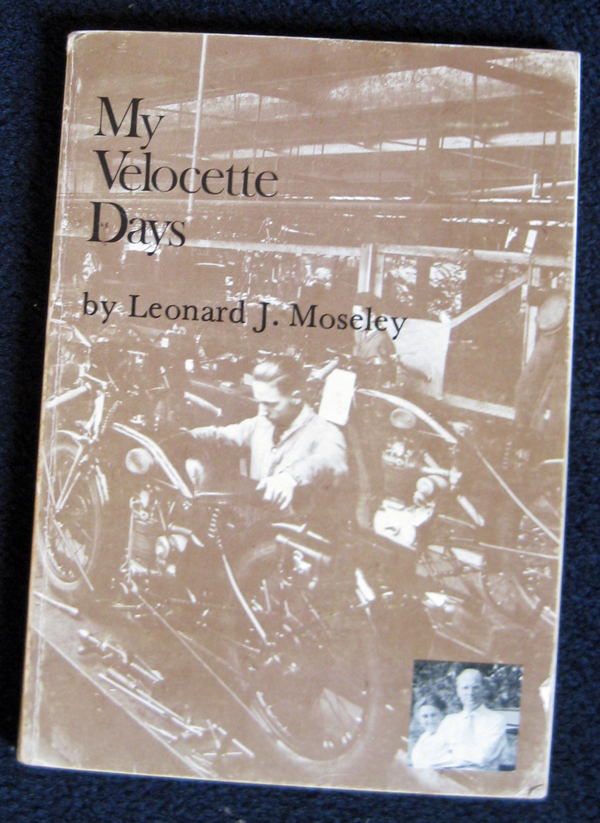
Cover of My Velocette Days by Leonard J. Moseley

Cover of My Velocette Days by Leonard J. Moseley


My Velocette Days
By Leonard J. Moseley
Transport Bookman Limited
1975 London England

This book is a great addition to anyone curious about motorcycle history. It is a must-read for the person interested in the Velocette marque. Unfortunately it is also a rare, out-of-print book that collects three digit prices in online sales. So, do what I did, borrow it from a friend and absorb as much as possible before returning the book (in the same condition it started in).

My Velocette Days was written by Leonard J. Moseley, a man who worked at the Velocette factory for 48 years, from March, 1923 at the Six Ways factory, through Hall Green and the subsidiary factory in the Fillerys Toffee Works in Greet, Birmingham and back to Hall Green, until 1970, just before liquidation of the company. The linear structure of this book is chock full of names, both of motorcycle models and the people who were involved with the company. Racing history and the motorcycle shows are also included as they involved the author directly.

Overall, this book illustrates the arc of a small manufacturing company during a certain era of human history. Innovative design and the attention to quality made the name, Velocette, known to the motorcycling world. Great success in the competitive world of racing and record-setting increased the popularity of the product. World War II changed all of this. During the war, the Velocette factory stopped producing motorcycles and worked mostly on aviation equipment. After the war, well, the world was just changing too fast and in ways few leaders could predict.

Moseley describes the decades of his experience succinctly. In very few words, he captures the excitement of the pre-war years. Winning the prestigious the Isle of Man T.T. was the epitome of success. To describe the war years, Moseley keeps to the facts of war contracts and numbers of people working, but the pain of these years comes through. After the war, he was asked to step down from a foreman position to an under-foreman role, and he mentions having a few moments of hard feelings, but does not dwell on this. Instead, he shows the exhilaration of resuming pre-war activities such as racing and motorcycle shows. Throughout his description, Moseley includes thoughtful perspective about how world events and economics influenced the quality of the labor force.

The demise of the Velocette company is depicted in facts such as production numbers and the departure of other characters. Only the passage of years shows how excruciating this process must have been. Moseley gets caught up in a few words of self-pity in his later years, but he expresses little bitterness. Primarily, Moseley depicts the camaraderie and innovativeness that the Velocette marque resonated with in the last century, a mystique that inspires dedicated fans today.
Black and white photos from a variety of sources are included throughout the book. In addition there are three appendices which include more photos as well as specifications for some models.

Posted in Books, Velocette & other British Motorcycles | Tagged , , , , , , , | 2 Comments

What Real Motorcyclists do in the Winter

There are two lessons to this blog. One is that motorcycle mechanics doesn’t stop just because the weather makes riding uncomfortable. Oh no. When the weather turns bad, the real motorcyclist takes to his/her garage and gets busy. Motorcycle racers especially use all the down time to get their bikes as fine-tuned as possible and prepared for the next racing season. Other motorcyclists use this time to repair whatever failed, and to build those projects that came in a series of boxes, (but that is a separate story.) Winter is a time of discovery and becoming intimate with the bike.

The second lesson is this: motorcyclists have to pay attention to their bikes. When my friend, Fred Mork, drove from California to Barber, Alabama, he was determined to race. Previously, at Miller Sports Park, he’d noticed a small leak on his long-stroke Norton Manx. However, the bike ran strong and gave no indication that anything was wrong. (Leaks are common on vintage bikes). Mork assumed the leak was from something like a seal that hadn’t seated and didn’t worry about it.

Once in Barber though, he noticed that the leak was not going away, and it was getting worse. Although the bike ran reliably as ever on the Barber track, Mork cancelled his plans to go on to the races in Daytona, Florida. Despite his determination to race, and all the effort it took to get to the other side of the country, Mork had to acknowledge the leak indicated a worse possibility. But it wasn’t until he was back home, and had time in his shop that he found the real cause of the leak.

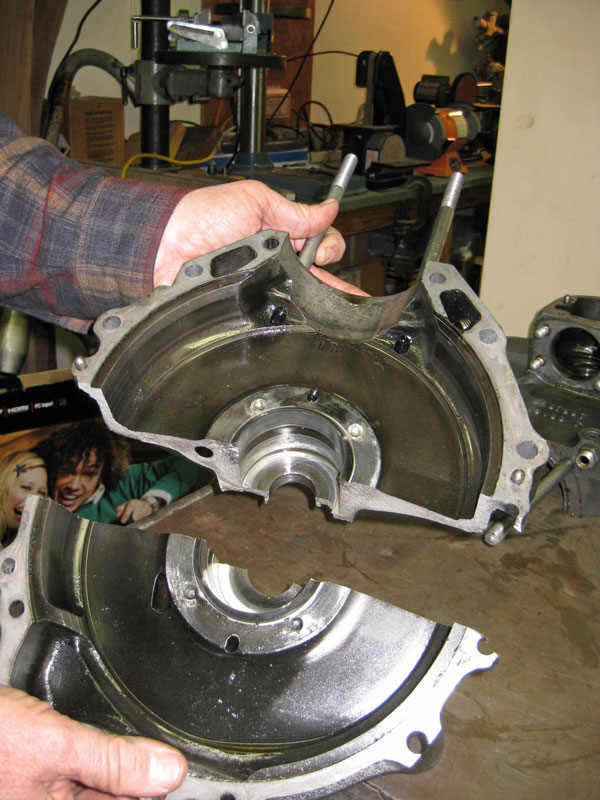
The two halves of a broken crankcase.

The two halves of a broken crankcase.


The unbroken half of the crankcase

The unbroken half of the crankcase

What looks obvious now, was not apparent from just looking at the bike. The crack started on the inside. As the crack grew, oil began to flow out of the crankcases, but otherwise nothing was visible. Mork had to tear down this part of the bike and split the crankcase to find out what was going on. Wear patterns from inside the cases tell the story. A story that could have been disastrous if Mork had continued riding, especially in a fierce competitive style.

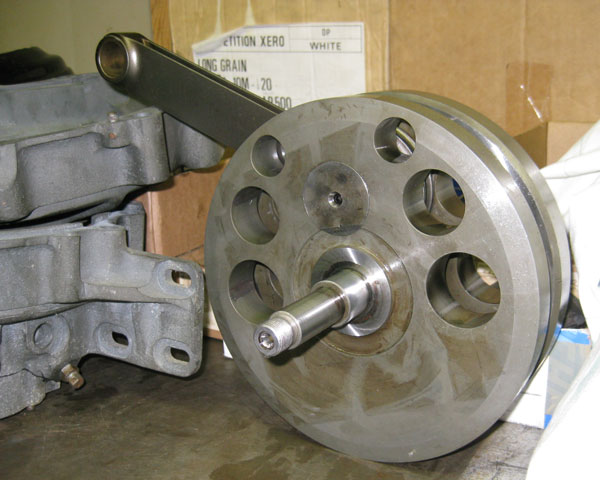
The beautiful fly wheel

The beautiful fly wheel

However Winter is not all about work. There’s still time to play. Here I am taking Mork’s paddle tractor out for a test ride in the show room.

Here I am paddling the tractor tricycle in Mork's show room

Here I am paddling the tractor tricycle in Mork's show room


Woo Hoo!  I'm going fast on that tractor!

Woo Hoo! I'm going fast on that tractor!

Posted in Velocette & other British Motorcycles | Tagged , , , , | Leave a comment

Book Review: The Tiger’s Wife by Tea Obreht

The Tiger’s Wife by Tea Obreht

Natalia, a young doctor from a Balkan country learns that her beloved grandfather has died under unusual circumstances. Knowing he has cancer, the grandfather, also a medical doctor, crossed the border and died in a small rustic clinic far away from his home. Natalia learns that he is dead as she waits to cross this same border in order to inoculate children on the other side.

How does a person understand the final acts of a person facing death? Natalia examines the two tales that were important to her grandfather, the tiger’s wife and the deathless man. Time and space bend as first one story and then another are told. Meanwhile Natalia witnesses the rituals of the people she visits. Characters and symbols weave the stories together, from the tiger in Rudyard Kipling’s Jungle Book to the tiger in the zoo of Natalia’s childhood to the tiger in her grandfather’s story. Ultimately this is a story about how the stories we tell ourselves create magic and ritual, prejudice and fear in life, more than it is about how to come to terms with death.

Although fantastical, the grandfather’s stories are told as if they were true or, at least, true to him. The tiger’s wife was a woman he knew in the village of his childhood and the deathless man was someone the venerable doctor encountered at opportune moments in his life. The possibility that Natalia’s grandfather traveled to the site of a recent tragedy in hopes of meeting with the deathless man resolves one narrative strand. The story of the tiger’s wife depicts the horror and tragedy that humans can inflict on other humans that they define as different. Both of these stories are beautiful and disturbing.

Folded into these stories are the rituals and beliefs humans have created about life and death. Natalia encounters some of these as she goes about her work of inoculating children. For instance, one family has more faith in the value of digging up the body of a dead relative to cure their children than in modern medicine. But science and myth are not contrasted as polar opposites here.

What is important here is not whether one belief system is better or truer than another, but how to accept and respect all the variations. As Natalia researches the stories that her grandfather told, she reports how the details vary depending on the speaker. Natalia describes the variations and selects which story she likes the best.

Aside from the beauty of the stories, this novel depicts a land torn apart by war. Obreht neither avoids violence nor sentimentalizes it. Horrific acts are related matter-of-factly. The combination of war and fantasy, left me feeling slightly dissociated.

If this sense of numbing disconnection was an intended response, then the author did something amazing with this book. Unfortunately this feeling left me feeling dissatisfied. This is not a novel of suspense nor is it cathartic. Natalia does come to terms with her grandfather’s death enough to voice his opinion from beyond the grave. She tells her partner that her grandfather would have advised her to tell her story, tell her tale. However the character Natalia is not freed by learning the truth; she demonstrates no joyous resolution. Instead Natalia seems to dissociate and fade from the pages. For this reason, I didn’t love the book as much as I wanted to. Despite this, I believe this is an important book, one I encourage everyone to read.

Tiger in the water
Cool photo By B_cool from SIN, Singapore (originally posted to Flickr as Tiger in the water) [CC-BY-2.0 (www.creativecommons.org/licenses/by/2.0)], via Wikimedia Commons (great resource for images)

Posted in Books | Tagged , , , , | Leave a comment

2011 BSA OCNC ALL BRITISH RIDE

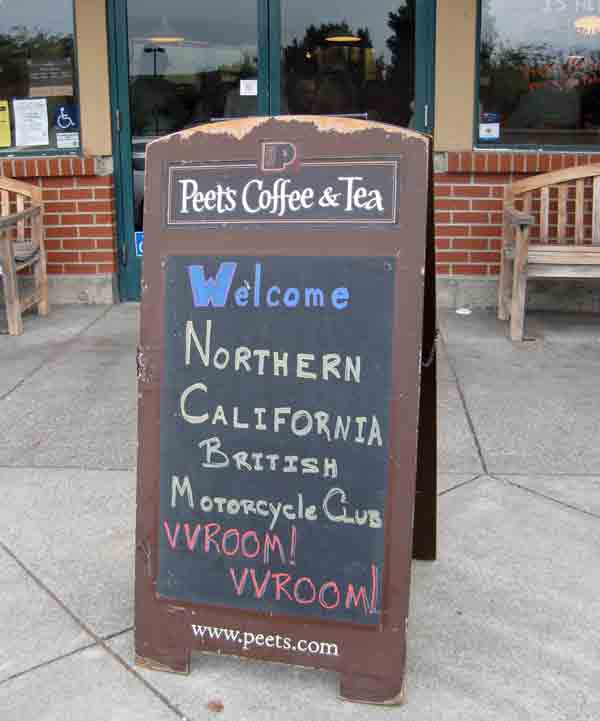
Welcoming sign from local Peets Coffee and Tea

Welcoming sign from local Peets Coffee and Tea


Time plays it’s usual tricks. Less than one week after the 49 Mile ride, we were back on the road for the BSA Owner’s Club of North America (BSAOCNC) All-British Ride. But in six days the weather had changed, the season had turned. Instead of glorious sunshine, the threat of rain followed us most of the day. It cut the lunch festivities short and caught up with us on the final leg home.

This ride was also marked two other anniversaries, the end of major motorcycle events of the year and the birthday of Don Danmeier. Danmeier founded the BSA OCNC many years ago and he started this particular ride as a celebration of his 50th birthday. For many years it was called the XXX anniversary of Don’s 50th birthday ride. While the accounting of Danmeier’s age has eroded over time, the ride is still popular. For an interview with Danmeier, see Pete Young’s blog, Occhio Lungo

Danmeier, in the middle of the picture, oversees the registration table.

Danmeier, in the middle of the picture, oversees the registration table.

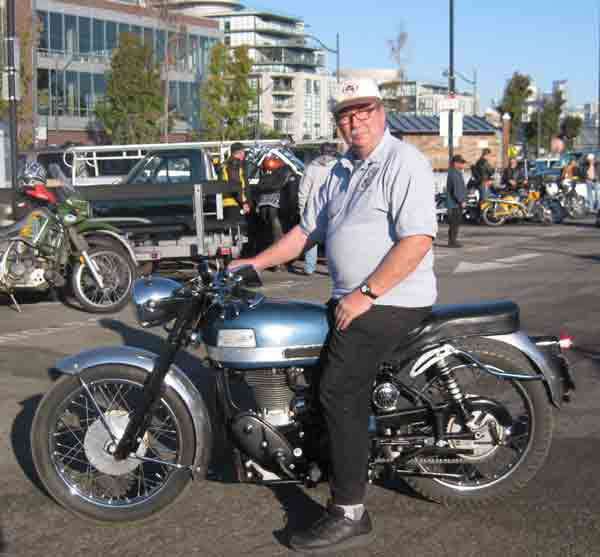
In earlier years this ride was only for a certain elite group. To go on this ride you had to ride the route on a British motorcycle. Party crashers who turned up on other kinds of bikes were subject to all sorts of abuse. People who owned British bikes but turned up on something else were turned away. Although, neither ride leader nor peer pressure was inclined to enforce this rule this year, I chose to leave my American built motorcycle behind and ride on the back of a Velocette Endurance.

Rider's prepare to go.

Rider's prepare to go.


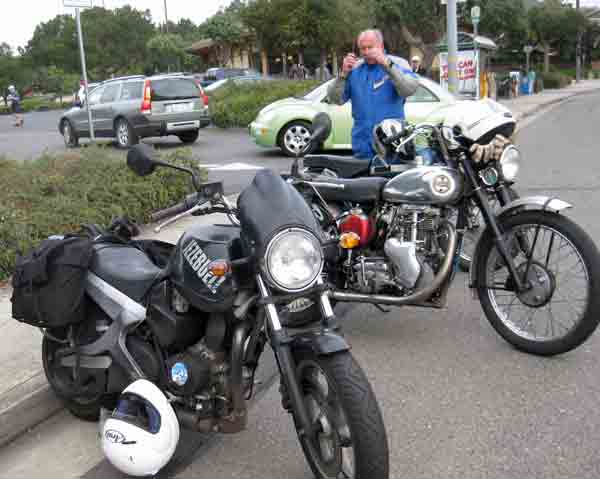
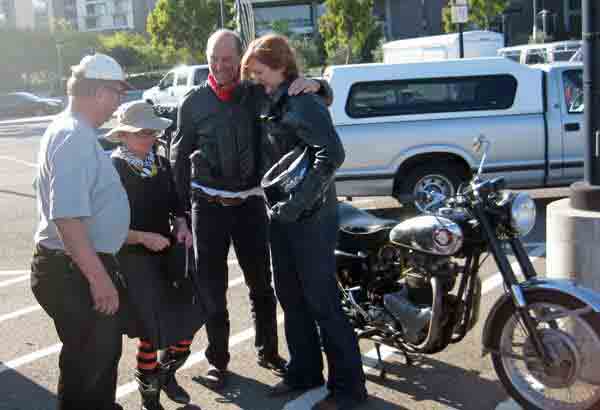
On Saturday morning, Fred, Jeff and I rode to Novato where over a hundred British motorcycles were gathering. Here I ditched my JezeBuell, we drank coffee and greeted old friends. Although predominately a BSA ride, all sorts of British bikes were present. Ariels, Greeves, Matchless, Nortons, a Panther, Triumphs, Velocettes and Vincents had also been prepped for this ride.
After removing my helmet and saddlebags from my Buell, I jumped on the back of the nearby Velocette Endurance.  Fred Mork with his Velocette Venom is in the background.

After removing my helmet and saddlebags from my Buell, I jumped on the back of the nearby Velocette Endurance. Fred Mork with his Velocette Venom is in the background.

The route was similar to previous years, except that we went in the opposite direction. The ride went through Fairfax and west up the Fairfax Bolinas road into Mount Tamalpais and then north to Point Reyes, finally stopping at the Cheese Factory for a bbq lunch.

On the way to Farifax, a few of us stopped to admire Paul’s new property.

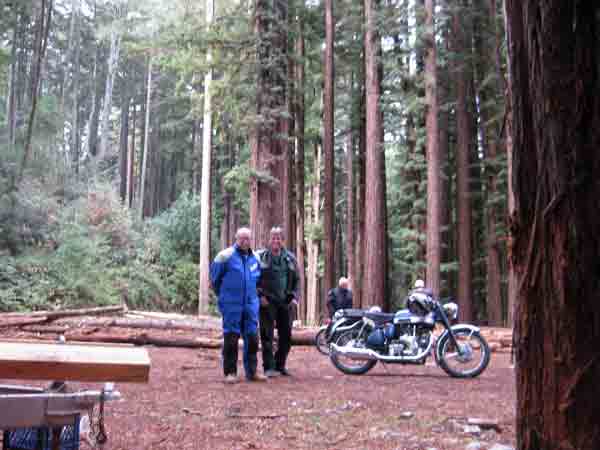
Fred Mork and Paul Zell on Zell's new property.

Fred Mork and Paul Zell on Zell's new property.

I renewed my respect for the people who ride as passengers on motorcycles. It is easier in that you don’t have to concentrate on the road, but you still have to pay attention to what is going on around you and try to keep some sense of balance. In addition riding on the back is significantly more frightening. There was red sawdust all over the slightly damp Fairfax Bolinas road, which made this twisty road appear more treacherous than usual. However the sun was out as we came over Mount Tam and there was an amazing view of the city in the distance that I, as a passenger, was able to enjoy.

Julie-and-Paul-Zell are ready to leave Pt. Reyes

Julie-and-Paul-Zell are ready to leave Pt. Reyes

Unfortunately we got lost at the end and arrived late for lunch. There was plenty of food, though. BBQ chicken and ribs, a sauté of vegetables and tofu, salad, garlic bread, cookies and plenty of hot coffee.

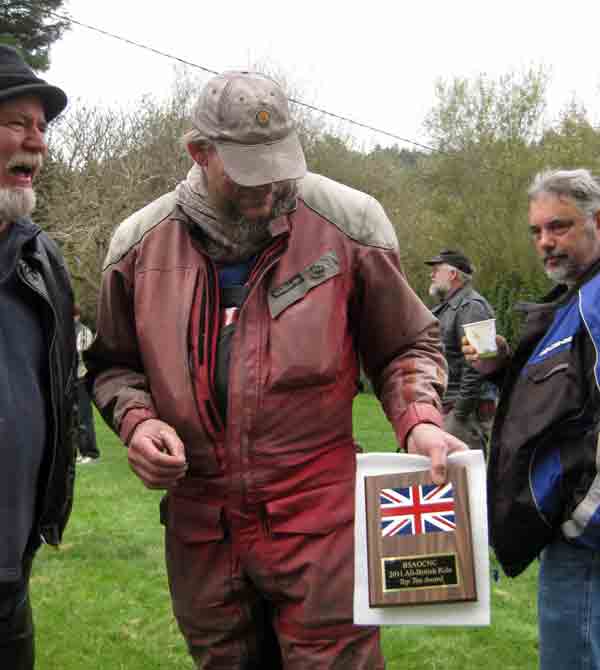
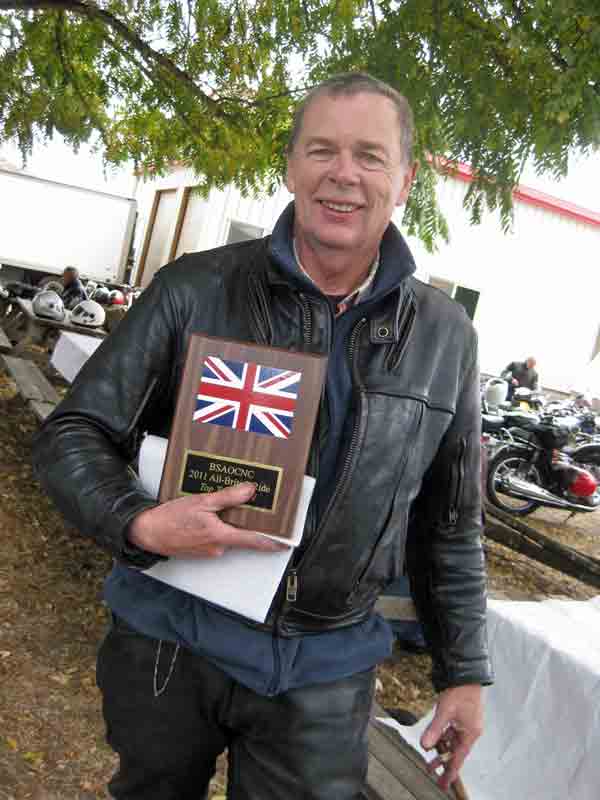
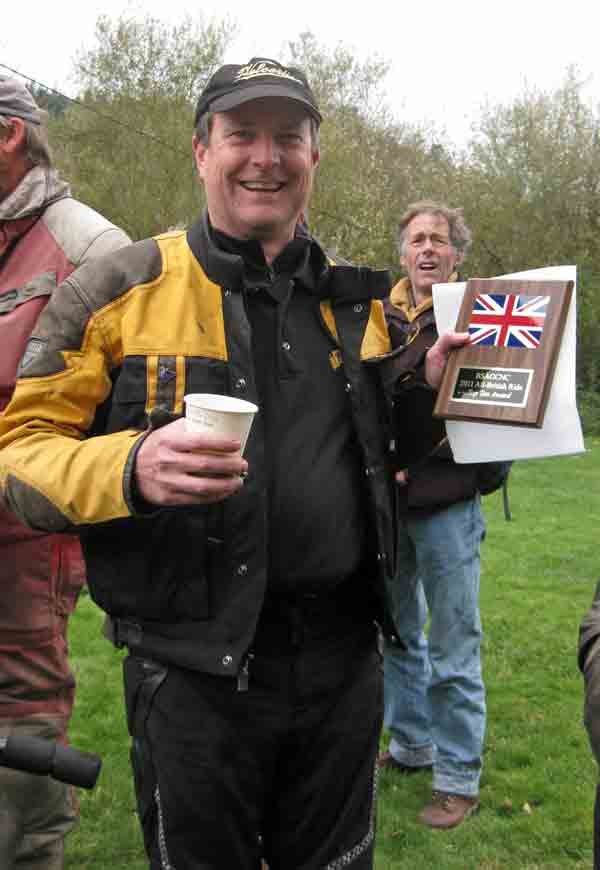
While I ate, Don gave out awards. This year many Velo-folk were recipients of these coveted plaques.

Jeff Scott wins for rattiest Velo

Jeff Scott wins for rattiest Velo


Another Winner  Frank Recoder

Another Winner Frank Recoder


Another Winner  George Shoblo

Another Winner George Shoblo


Another Winner  John Frei

Another Winner John Frei

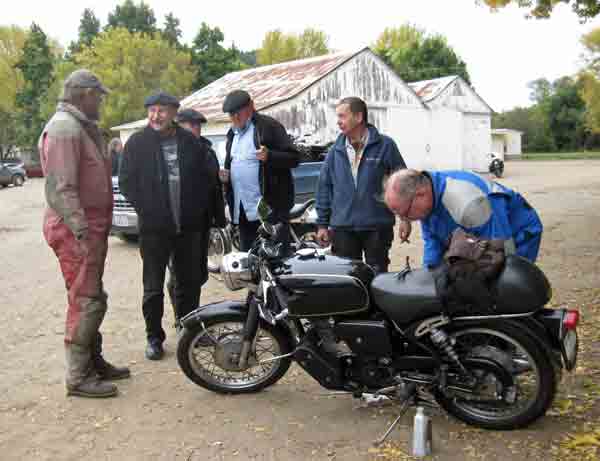
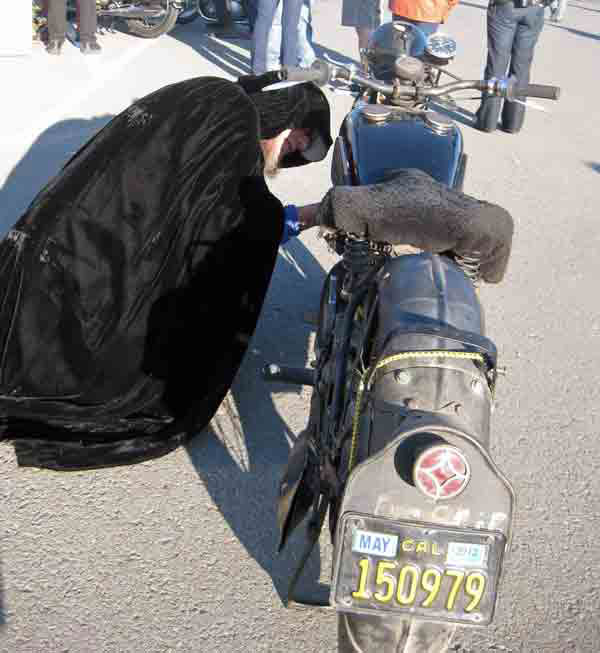
Most people had left by the time, I realized that George Shoblo was pulling out his tools. The Thruxton Velocette that he’d loaned Blaise had lost timing screws. Blaise realized this when his boot responded to the oil leaking out and slipped off the footpeg. George sat with the bike while Blaise rode George’s modern Matchless to Paul Z’s home to beg, borrow or steal screws of a certain size.

George explains the problem

George explains the problem

By the time Blaise had returned with the screws those of us who were nonchalant about riding in the rain had gathered around George’s bike to give him advise, discuss worse case scenarios (losing the prime on the oil), and generally give support.

While Fred pours oil in the bike, others give George advice

While Fred pours oil in the bike, others give George advice

Fortunately Blaise managed to get enough screws to hold the bike together, the oil returned and it looked like everyone was going to be able to make it home on the vehicle they came on.

Blaise arrives with the screws

Blaise arrives with the screws

Thanks to Don and Shirley and BSAOCNC who helped put this ride together. It is amazing to see the fabulous countryside of Marin from rolling hills to redwood forests and magical beach towns. Every year I promise to return and do the ride on my own bike. Of course this ride often signals the start of the rainy season and I postpone optional rides until the sun comes out. By then, I’ve forgotten how beautiful these nearby country roads are.

Posted in Velocette & other British Motorcycles | Tagged , , , , , , | Leave a comment

Book Review: The Marriage Plot by Jeffrey Eugenides

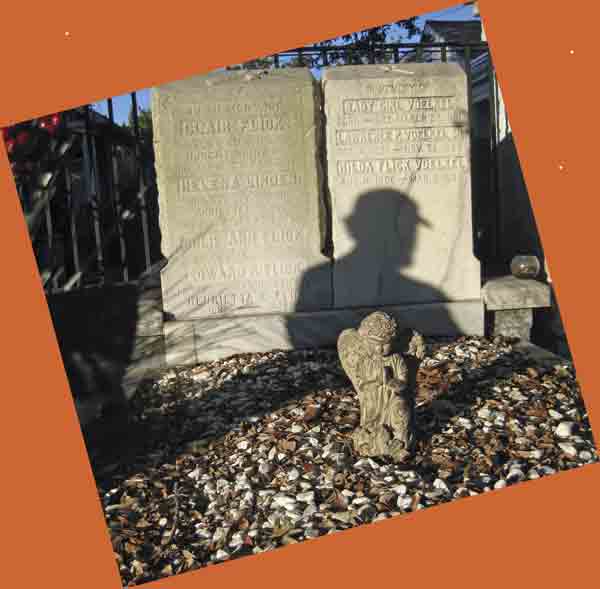
I took this photo of a burial  plot in New Orleans with shadow of a man and small statue of an angel.

I took this photo of a burial plot in New Orleans with shadow of a man and small statue of an angel.

Here’s a book I had great expectations for. I’d enjoyed Eugenides’ previous novel, Middlesex. His new book promised something even rarer: a heroine that I could relate to. One thread of the story follows Madeleine who graduates from college in 1982, just like me. Also just like me, this woman studied English Literature. This setting combined with the title, promise that the character, just like me, worked out her understanding of the world through the literature she read.

Despite all my expectations, the novel is a disappointment. If I’d hoped for a novel to make sense of that time of life, I’d have to look elsewhere. Sure the recession of the early ‘80’s is mentioned, but Madeleine is insulated from experiencing it, because her family is rich. On top of that she is beautiful and sane and well, rather boring. Where are the drugs, the clubs, the shock of AIDS?

So I don’t recognize the setting and can’t relate to this character. The other two main characters, Leonard and Matthew, narrate alternate chapters, but they also do not gain my sympathy. Leonard discovers he is bipolar (manic-depressive in the language of 1982) and Matthew goes on a religious quest that doesn’t even include the fun of the New Agers. Early on, I realized that I didn’t care what happened to the characters and wondered if finishing the book was worth my time.

With my expectations foiled, I continued to read with a new question. How do I evaluate this book? Basically there is no plot beyond the girl gets boy, boy dumps her, girl gets another boy, he dumps her and she concentrates on an academic career. In other words, nothing happens in this book. So maybe the traditional qualities of plot, character and setting don’t apply to a post-modernist novel. What else is there?

Ultimately I read this book as a novel of ideas. There is plenty in the novel for a student to analyze and discuss in a classroom setting. I can imagine the assigned questions: Define Kierkegaardian and how it relates to this book. Discuss the polarities of science and religion as they are portrayed in this book. Compare Madeleine to a Jane Austen character like Elizabeth Bennet from Pride and Prejudice or Emma. What is the difference between a Modernist novel and a Post-Modernist one?

While there is a myriad of ideas possible, none are developed in this novel. Philosophy is mentioned, courses in semiotics are described, the polarity between science and religion is set up, but none seem integral to the book. One stated theme: “People would never fall in love if they hadn’t heard love talked about” from François de La Rochefoucauld could be interesting. However these characters are incapable of love.

There is one redeeming section, where Eugenides shows off his best writing. This occurs when Eugenides describes the sex between Madeleine and Leonard. Fantasies and how they get played out is fun to read about, but here something daring and slightly dangerous comes alive on the page. However just as the characters never speak about what happened, the novel never returns to this thread.

Aside from this fantasy section, the great beauty of the language kept me reading, for a while. Then I started to skim the mind-numbing details. These details do not move the plot forward, or contribute to character development. Maybe in a post-modern existential world, these things don’t matter, but they still do to this reader.

In the end, Eugenides seemed to write himself into a corner and then had to use an awkward spiritual revelation, one of those heavy-handed authorial tricks, to bring the book to a conclusion. It’s as if he had a contract with his publishers to write a novel of a certain length and he’d reached the quota.

Both of the male characters love Madeleine enough to leave her. This is a strange idea to sit with. The suggestion is that she’s supposed to do something more important than marriage. This is a great plan! But, in all the previous pages, there was no evidence that she had it in her to do anything. Between daddy’s money and help from Leonard to get her article published and having Matthew to fall back on, she showed no sign of any kind of originality or other strength. If Matthew didn’t have his spiritual revelation and pull out of the relationship, Madeleine might very well have married him, with the usual boring results.

The novel ends with Madeleine stating “yes.” This echoes the ending of James Joyce’s Ulysses, a great Modernist novel. Both Molly Bloom’s “yes” and Madeleine’s “yes” are affirmations of life. But both of these female characters came out of male minds. Fortunately there are many other books to read and to be written.

Posted in Books | Tagged , , , , | Leave a comment

2011 AMCA 49 Mile Ride

It looks like I'm teaching Fred, Jeff W. and Amy dance steps, but that can't be right.  Nearby is Jeff W's BSA

It looks like I'm teaching Fred, Jeff W. and Amy dance steps, but that can't be right. Nearby is Jeff W's BSA


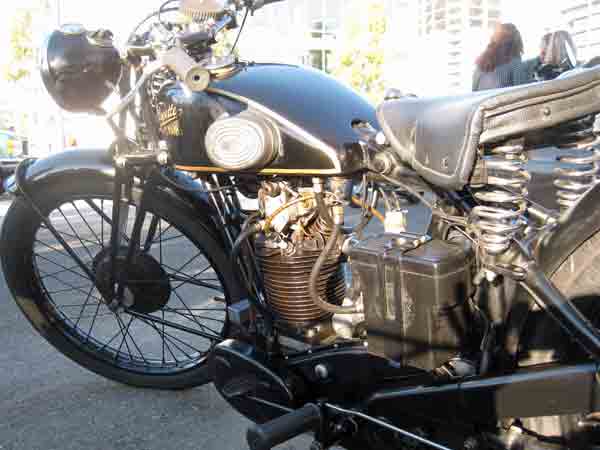
On the Sunday before Halloween, around 300 bikers gathered to show off their clutch and throttle skills throughout the steep hills of San Francisco. What is especially remarkable is that the majority of these bikes were built before 1974. Many were much older. My riding partners included a Velocette Venom from the early 1960’s and a Velocette two-stroke GTP from 1946. It is hard to believe how much knowledge and coordination is required to ride these older vehicles. Suicide clutches, kick-start ignition, and piston seizures were common concerns.

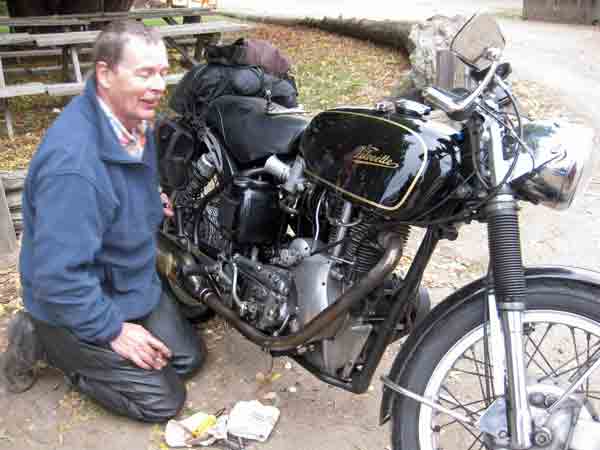
Fred Mork on his Velocette Venom

Fred Mork on his Velocette Venom


Jeff S has a quiet moment with the Velocette GTP

Jeff S has a quiet moment with the Velocette GTP


(I tagged along on a modern motorcycle, but I’ve come a long way from the days when I was afraid to drive my V.W. bug to the Haight)

The timing of this ride is far from ghoulish. Some of the best weather in the SF Bay Area happens in the Autumn. If it’s not raining, it’s clear and sunny and warm – as this day was.

Pete and Kim Young, of the Yerba Buena Chapter of the Antique Motorcycle Club of America, organize this one-day ride that loosely follows the 49 Mile Scenic Drive. This route features many famous San Francisco landmarks, including Pier 39, Fisherman’s Wharf, Alcatraz, the Presidio, The Great Highway, Golden Gate Park, Twin Peaks, and the Castro. However, this ride began and ended at a site that doesn’t usually make the tourist’s list, the Bay View Boat Club.

Pete Young - notice the ride t-shirt

Pete Young - notice the ride t-shirt


The Young's sidecar rig.  Pete rode with Sirisvati on the back and Atticus in the chair.

The Young's sidecar rig. Pete rode with Sirisvati on the back and Atticus in the chair.


Kim Young's Velocette in the morning light

Kim Young's Velocette in the morning light


Before the ride it was enough to greet the people I know from the Velocette Owner’s Club of North America and related events. George and Satchi Shoblo, Terry and Noreen Norbert, Don Danmeier, Shirley, Frank Recoder, Frank Forster, Jeff Ward and his beautiful bride Amy, Lynn Miller…

The ride followed the waterfront, traveling past Pier 39 and Fisherman’s Wharf and then darting into the City. I was still becoming accustomed to riding with such a large party. It’s not that everyone rode together – there were too many bikes and too many styles of riding to allow that. Still there is a sorting out process. The fast boys have a need to pass… and they will whether you’re ready or not. Other riders are visually trembling with the shock of being up so early on a Sunday morning. Still others are focused on remembering which side the brake is on and where is the clutch. All in all, it means that you need to be aware of your surroundings. You rarely have a lane all to yourself, and if you do, someone is right behind you deciding whether to pass on your left or your right.

So about this dart into the City. My group was in the right hand lane when we saw a volunteer signal that we were suppose to turn left into the city. Here. Left. The driver of the car in the left lane politely stopped back far enough for us to go across his line of travel and into the left turn lane. This was the first of many courteous and generous car drivers we met throughout the day. I guess what they say is true: everybody loves a parade.

So, with all that going on, I was taken by surprise to find myself on the top of Lombard Street. There was nowhere to go but down, down and around, and down the one-way 8-hairpin turns of Lombard Street. I was too busy plying the clutch and brake to pull the camera out, but others have posted photos and views of this acrobatic feat.

Pete has posted photos and links on his blog: Occhio Lungo.

Back along the waterfront towards the Presidio, where there were plenty of detours and unmarked corners. I tucked behind one of the ride hosts, Kim Young and hoped she knew where we were supposed to go. After a complicated scenic route, we ended up at a parking lot for Baker Beach. There was a spectacular view of the Marin Headlands, and the west side of the Golden Gate Bridge. This is an incredible pocket of natural beauty tucked into a forgotten corner of the great city of San Francisco. I overheard many people talking about how long it has been since they visited this site and wondering why they didn’t come here more often. I also spoke with a man, many years my senior, who described surviving a crash when a boulder fell off a hillside and on to him. He rides again today, because the worst thing is living in fear. Hallelujah!

The ride continued following the waterfront in a more southerly direction. Just past Ocean Beach we encountered another San Francisco standby, the fog. There was plenty of car traffic so no one was ride beyond what they could see. In fact, this car traffic became potentially problematic at intersections where there was no traffic control. One lone rider on a Harley pulled his loyal steed into the line of traffic and stopped one direction so that many riders could get through.

The ride stopped again on the top of Twin Peaks. There was a great view of the city below, but most of the excitement was happening within small groups of the ride. Here I was able to speak to many people I know who ride as well as meet people. I love the introductory comment, “Hey, I’ve seen this bike around Vallejo and wondered who rode it.”

The last leg of the route was down the hill, along Market to 16th and back to the Bay View Boat Club. Here a surprisingly tasty lunch of Caesar salad, garlic bread, pasta and beef was served. And there was more time to talk. I met another woman who rides and keeps bees, but I never found out who rode the other Buell Blast on the ride. Hopefully we’ll be on another ride together.

Thanks to Pete and Kim (and Atticus and Sirisvati) as well as the many volunteers who directed the ride at strategic corners. And special thanks to Larry.

View of a parking lot full of motorcycles at Baker Beach

View of a parking lot full of motorcycles at Baker Beach

Posted in Velocette & other British Motorcycles | Tagged , , , , , , , | Leave a comment

How to extract Honey from the Comb

Bees create the honeycomb, the perfect six-sided cells, that they then fill with honey. Once full, the bees seal these containers with more wax. If you want to taste honey as the bees made it, nothing is better than to eat the honey with the comb.

However, many people are used to the liquid gold of fluid honey. Typically, to extract the honey, a hot knife is used to decap the honeycomb and then the frames are spun so the centrifugal force spins the honey out. When Jeff and I tried this, we both noticed that the application of a hot knife changed the taste of the honey. The heat seemed to rob the honey of its top notes, the lighter floral essence. Recently I saw this process being done with a metal comb. The comb broke the wax so the honey could drip out. This might be worth trying.

As to spinning, well basically this process aerates the honey and the flavor is weaker afterwards.

For us, with our goal of preserving the flavor of the honey, the simplest way to extract the honey is the most successful. We cut the comb from the frame and put it into a strainer. We break up the cells with our hands and let the honey drip out.

Jeff makes a face as he cuts honeycomb from the frame.

Jeff makes a face as he cuts honeycomb from the frame.


The honeycomb falls from the frame into the waiting strainer.

The honeycomb falls from the frame into the waiting strainer.


Hands prepare to squeeze....

Hands prepare to squeeze....


It's a messy job, but someone has to do it....

It's a messy job, but someone has to do it....

the final result

the final result

Posted in Uncategorized | Leave a comment

Bee-giners first question

Honey in fars and rounds

Honey in fars and rounds

People often tell me that they are interested in keeping bees and then ask how much equipment and time is needed.
Really, the only true answer is, it depends….
Most importantly it depends on what you want to do with the bees.
If you want to set up a sustainable microcosm in your own living area and have the bees fertilize your own crops, then you don’t need much. I’ve met farmers who are aware of bees living in trees or abandoned buildings. Here the bees take care of themselves. The farmers benefit from the pollination, and “keep” bees means not chasing the bees away.
However most of the people who ask me this question live in a more urban setting.
The first thing is to check with local ordinances about keeping bees.
Beyond that all you need is a bee-ginner kit such as from the Brushy Mountain Bee Farm and some bees. The bees can be purchased online and delivered in the mail. Alternatively, bees are often readily available from other beekeepers, especially in the Spring. The kit supplies a hive body, bottom, lid, some frames, wax foundation, a smoker, gloves and head protection.
Once you start wanting to steal some of the honey, then you need more equipment and more time. Extracting honey or packaging comb especially take time and space – believe me the honey gets everywhere. The ideal is to have a honey house, but if that is not in the budget, schedule time for cleanup.
The usual drill is this. You put your protective gear on and lift the lid to the hive. The frames appear to be full of honey. Using a hive tool, you could lift up one of the frames to check. If you determine that it is time to remove the super, you lift the super to place a bee excluder underneath.
Here I am lifting the lid to a tall hive.

Here I am lifting the lid to a tall hive.


There are a couple of things to be aware of here. One is that the bees will have secured the super to the lower surface with propolis. The hive tool applies leverage to break this glue, but it often needs to be applied in more than one place. Once you get it free, you need to lift it and set it in a temporary site.
Using a hive tool to scrape off burr comb.

Using a hive tool to scrape off burr comb.


A super full of honey and bees weighs between 35 and 50 pounds. Even if you are able to lift this much weight easily in the gym, you must remember than now you are lifting it while you are smothered with bees. Well, smothered is an exaggeration. But there will be a lot of bees, on every surface of the hive and in the air. Basically, you want to move the super slowly and smoothly, and avoid killing any bees.
It has happened that I’ve done this stage while there was a heavy flow of pollen going on and the bees have practically ignored me. I have learned to avoid doing this stage while rushed to be somewhere else, or when the day has cooled down, or when the bees just tell me to go away. They do tell me – they buzz louder. Once you catch the attention of the guard bees, more bees attempt to scare or sting you away. Using a smoke helps, but sometimes it’s best to just return another time.
Anyway this is stage one. If everything goes smoothly, it takes a half hour. The next day, you return and remove the super. It should be empty of bees or have only a few left and they will fly away on their own after you carry the super away from the hive. Again this can be done in a half hour.
Here I am setting a super onto a wagon.

Here I am setting a super that is free of bees onto a wagon.


Then the fun begins. First you dismantle the super. If you want to extract the honey from the comb, you set the frames aside. They honeycomb should be capped indicating the bees are finished with it. You cut off the top layer of wax with a hot knife and then put the frames into a spinner. Once set into motion (by hand or electricity) centrifugal forces spray honey out of the comb onto the walls of the spinner. The honey then collects on the bottom.
Since my partner and I discovered that the application of heat and aeration changes the flavor of the honey (and since we’re working with small amounts), we break the honeycomb by hand and let it drip through a sieve. This ensures the flavor remains as close to the original as possible.
Another option is to set up frames with rounds, which the bees fill. (These are usually called Ross rounds). These just need to be capped, sealed and labeled.
Then the equipment is ready to be cleaned and set up for the next harvest.
This processing can be time consuming and is usually sticky, but the result is sweet!
Caps and rounds

Caps and rounds


While all that answers the question, it doesn’t really cover three essential elements necessary to keep bees.
The real first concern is sunshine. Bees like lots of it. They like warm weather. Since I live near San Francisco, people from this city have asked me about keeping bees. My first question for them is whether or not they have a place to set a hive where it will get lots of sunshine. Some do. However, between fog and shade from other buildings, some bee lovers do not have access to a sunny space.
Besides sunshine the bees we have also require lots of water. Our hives often have an upside down mayonnaise jar with a perforated lid supplying water. In addition we have a water feature, basically a birdbath filled with stones and water. The stones help prevent the bees from drowning.
Bees will go to neighboring ponds, pools and other sources of water to get what they need. This interaction can irritate neighbors. So the most important element of keeping bees in an urban setting is to make friends with your neighbors. Giving gifts of honey can sweeten many dispositions.
Obviously bees also need lots of flowering plants and plants in general.
In some settings, bees also need protection from other animals that like the taste of honey, like raccoons, bears etc.
So the real answer for what is necessary to keep bees is sunshine, water, flowers, and friendly neighbors. Some effort to protect yourself from stings and the bees from predators may also be necessary.

Posted in Uncategorized | Leave a comment

Finally, a Honey Harvest!

A honey bee approaches buckwheat.

A honey bee approaches buckwheat.

Finally, the bees have produced enough surplus honey for us to steal some. This year they have been much more interested in making bees. While increasing the bee population is itself a good thing, we’ve been missing our honey! We didn’t even have any for our own toast! Usually by this time of year we have enough surplus honey to give away as wedding favors or to donate to friends’ mead projects. Not this year.

To harvest the honey, we first open the hive and lift off the supers that we want to take. If there is a flow of pollen going on, the bees are quite calm while we do this. They are generally happier when the sun is shining and lots of flowers are blooming. However, if it is cool, or windy or flowers aren’t blooming, or it’s late in the day, the bees will get quite upset with us for lifting off the lid of the hive. Although we are as gentle as possible, gentle on a human scale is devastating to the tiny bee. While the workers are dehydrating nectar and maintaining a constant temperature inside the hive, we invaders are at the very least are letting a huge draft of air in.

Here I am taking the lid off a tall hive.

Here I am taking the lid off a tall hive.


Setting super aside so I can put the bee excluder under it.

Setting super aside so I can put the bee excluder under it.


Even if many bees are out collecting pollen and nectar, there are many other worker bees left in the super. To separate the bees from their honey, we place a bee excluder under the supers we want to take, put the super back on the hive and replace the lid. The bee excluder allows the bees to get out of the super, but not to return.
bee excluder

a bee excluder board


About 24 hours later we return, take the lid off and remove the super again. This time it will be relatively bee free. We also take off the bee excluder and save it for future use. Often we give the hive an empty super at this time.

Once we’ve stolen the honey, we process it as little as possible. Since we find that the tools often used in extracting honey such as a hot knife to uncap the comb and a centrifuge to get the honey out of the comb, changes the flavor of the honey, we don’t do use these tools. Instead we simply cap the honey rounds or let the honey drip through a sieve.

The result is honey that is as close to what the bees made as possible.

Jeff holds a tray with rounds of bee comb and honey.

Jeff holds a tray with rounds of bee comb and honey.


Although harvested at the same time, the honey from different hives, looks and tastes different.

Although harvested at the same time, the honey from different hives, looks and tastes different.

Posted in Bees and Honey | Tagged , , | 2 Comments